Can someone easily explain Artin's conjecture on primitive roots?
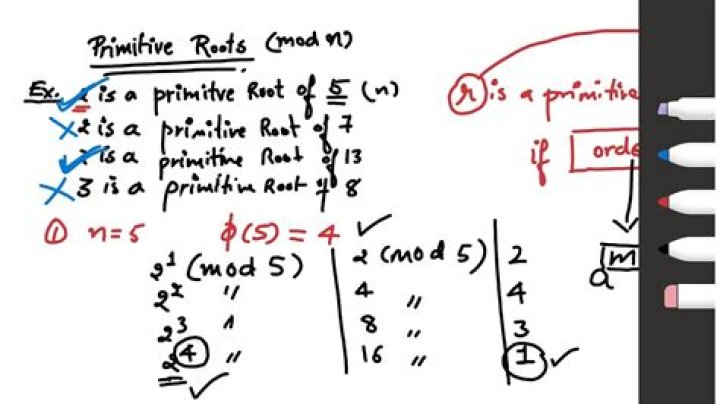
Wikipedia (1): In number theory, Artin's conjecture on primitive roots states that a given integer a that is neither a perfect square nor −1 is a primitive root modulo infinitely many primes p.
and
Wikipedia(2): In modular arithmetic, a branch of number theory, a number g is a primitive root modulo n if every number a coprime to n is congruent to a power of g modulo n.
These two definitions seem to be enough to understand Artin´s conjecture in its formulation, however, I am facing some difficulties, so if someone can explain this conjecture very easily that would be nice.
Thanks.
$\endgroup$ 71 Answer
$\begingroup$A base $a$ is a primitive root modulo a prime $p$ , if the smallest positive integer $k$ with $$a^k\equiv 1\mod p$$ is equal to $p-1$ , the largest possible order. Artins conjecture is that for every base $a\ge2$, there are infinite many primes $p$ doing the job.
$\endgroup$