Can a relation that is NOT a function be one-to-one or onto?
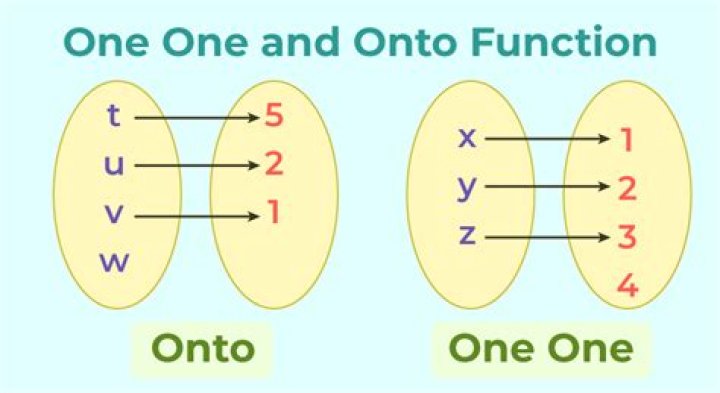
Let $A = \{1,2,3\}$ and $B = \{7,8,9\}$. For the relation between $A$ and $B$ given as a subset of $A \times B = \{(1,9), (1,7), (3,8)\}$, $A\times B$ is not a function because $1$ appears as the first element in more than one ordered pair. This made me think about the following generalized question.
If a relation is not a function, then it is only a subset of $A$ and $B$ denoted as $A\times B$. Then can this subset be one-to-one? Can it be onto?
One-to-One?: Even though $A\times B$ is not a function, I believe it satisfies the requirements of being one-to-one because in $A$, $x_1 = x_2$ only when $x_1 = x_1$.
Onto?: I want to say yes also. The range of $A$ could be the range of $B$. If $A \times B = \{(1,9), (1,8), (3,8)\}$, then does this satisfy the requirement of being onto?
Basically what is piquing my curiosity is if non-function relations can be one-to-one or onto or if being one-to-one and/or onto implies that it must be a function.
$\endgroup$ 21 Answer
$\begingroup$The answer here is yes, relations which are not functions can also be described as injective or surjective. You can read more about it on the wikipedia page here under the section titled "Special types of binary relations," but the definitions are the natural ones:
A relation $R\subset A\times B$ is injective if for all $a,a'\in A$ and $b\in B$, $(a,b)\in R$ and $(a',b)\in R$ implies $a = a'$.
A relation $R\subset A\times B$ is surjective if for each $b\in B$, there is some $a\in A$ such that $(a,b)\in R$.
Some examples will hopefully clarify:
If $A = \{\mathbf{1}\}$, a singleton with one element, and $B = \{\mathbf 1,\mathbf 2,\mathbf 3\}$, then the relation $R = \{(\mathbf 1,\mathbf 1), (\mathbf 1,\mathbf 2), (\mathbf 1,\mathbf 3)\}$ is both injective and surjective, and it is not a function.
If $A = \{\mathbf 1,\mathbf 2,\mathbf 3\}$, $B = \{\mathbf 1,\mathbf 2\}$, then the relation $R = \{(\mathbf 1,\mathbf 1), (\mathbf 2,\mathbf 1)\}$ is not injective, not surjective, and it is not a function.
If $A = B = \Bbb Z$, the set of integers, and $R = \emptyset \subset A\times B$ is the empty set, then $R$ is injective (hint: vacuous truth), it is not surjective, and it is a function (vacuous truth again).
If $A = \Bbb R$, the set of real numbers, $B = \Bbb R_{\ge 0}$, the set of non-negative real numbers, and $R\subset A\times B$ is the relation $R=\{(x,x^2): x\in \Bbb R\}$, then $R$ is a surjective function, but it is not injective.