Calculate the volume of a torus
I want calculate the volume of the solid obtained by rotating around the $z$-axis $$C=\{(x,y,z) \in \mathbb{R}^3\;:\; (x-R)^2+z^2\le r^2,y=0\}$$ with $0<r<R$. Can I use polar coordinates?
$\endgroup$ 22 Answers
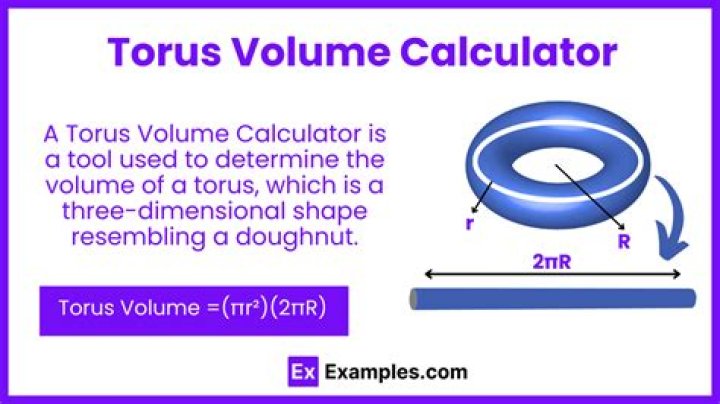
$\begingroup$By Pappus's centroid theorem, the volume of the torus is given by $2\pi R\cdot \pi r^2$.
The same result can be obtained by using integration and cylindrical coordinates: the torus is generated by the disc $C$ is $$T=\left\{(x,y,z) \in \mathbb{R}^3\;:\; \left(\sqrt{x^2+y^2}-R\right)^2+z^2\le r^2\right\}$$ and therefore $$\begin{align}\text{Vol}(T)&=\int_{\theta=0}^{2\pi}\int_{\rho=R-r}^{R+r}\int_{z=-\sqrt{r^2-(\rho-R)^2}}^{\sqrt{r^2-(\rho-R)^2}} dz \rho d\rho d \theta\\ &=4\pi\int_{\rho=R-r}^{R+r}\sqrt{r^2-(\rho-R)^2}\, \rho d\rho\\ &=4\pi r^2\int_{s=-1}^{1}\sqrt{1-s^2}\, (rs+R) ds\\ &=4\pi r^2R\int_{s=-1}^{1}\sqrt{1-s^2}\,ds=4\pi r^2\cdot \pi R \end{align}$$ where $s=(\rho-R)/r$ (the integral of $rs$ is zero by symmetry).
$\endgroup$ 6 $\begingroup$Using cylindrical coordinates (As $r$ is usually used in this coordinates I will use $S$ instead): by symmetry, $(x-R)^2 + z^2 = S^2$ gives
$$ (r-R)^2 + z^2 = S^2 \implies r = R\pm\sqrt{S^2-z^2},\quad z = \sqrt{S^2-(r-R)^2}.$$ $$ V = \int_0^ {2\pi}\int_{-S}^S\int_{R-\sqrt{S^2-z^2}}^{R+\sqrt{S^2-z^2}}r\,drdzd\theta = \cdots $$ $$V = \int_0^ {2\pi}\int_{R-S}^{R+S}\int_{-\sqrt{S^2-(r-R)^2}}^{\sqrt{S^2-(r-R)^2}}r\,dzdrd\theta = \cdots $$ (What is better?)
Alternatively, you can do a cov adapted to the problem: $$ \eqalign{ r &= R + s\cos\psi\cr x &= (R + s\cos\psi)\cos\theta\cr y &= (R + s\cos\psi)\sin\theta\cr z &= s\sin\psi } $$ $$(s,\theta,\psi)\in[0,S]\times[0,2\pi]\times[0,2\pi]$$
$$ \eqalign{J &= \left|\matrix{ \cos\psi\cos\theta & -(R+s\cos\psi)\sin\theta & -s\sin\psi\cos\theta\cr \cos\psi\sin\theta &\hfill(R+s\cos\psi)\cos\theta & -s\sin\psi\sin\theta\cr \sin\psi & 0 & s\cos\psi }\right|\cr &= (R+s\cos\psi)s\left|\matrix{ \cos\psi\cos\theta & -\sin\theta & -\sin\psi\cos\theta\cr \cos\psi\sin\theta &\hfill\cos\theta & -\sin\psi\sin\theta\cr \sin\psi & 0 & \cos\psi }\right| = (R+s\cos\psi)s. } $$
$$ V = \int_0^{2\pi}\!\!\int_0^S\!\int_0^{2\pi}(R+s\cos\psi)s\,d\psi ds d\theta = \int_0^{2\pi}\!\!\!\int_0^S 2\pi Rs\,ds d\theta = \int_0^{2\pi}\pi RS^2\,d\theta = 2\pi^2 R S^2. $$
$\endgroup$