Calc II: Volume of Rotation About Y-Axis
I have the following questions and I need a bit of help setting up the integrals I have some portions complete but how do I set the integral in each case?
Ques. 1: Find the volume of the solid obtained by rotating about the y-axis the region between
$y= 3 + 2x -x^2, y= 0 $ and $y = -x + 3$
I have determined that the best way to solve would be with cylindrical shell. I have graphed the functions and determined its limits of integration to be $a = 0, b = 3$ and according to equation you have the following setup for a solution but i do not know what the proper radius would be in the situation (is it $-x^2 + 2x +3 + x$?):
$V = 2\pi \int_0^3 (shell radius)(shell height)$
$= 2\pi \int_0^3 ()(-x + 3)$
Question 2: Find volume of the solid obtained by rotating about the y-axis the region between:
$y = \frac{1}{x}, y = 0, x = 1, x = 2$
The first part of this problem was to solve via shell method which I completed and got a solution of $2\pi$. the second part is causing me problems. it is to find the same solution via washer method. My problem is that when using washer method your limits of integration must come from the y-axis. But when i set $\frac{1}{y} = 0$ the equation is not solvable so i do not understand how to get the limits. ultimately the setup should look something like:
$\pi \int_a^b (\frac{1}{y})^2$
Please excuse post length. thanks
$\endgroup$1 Answer
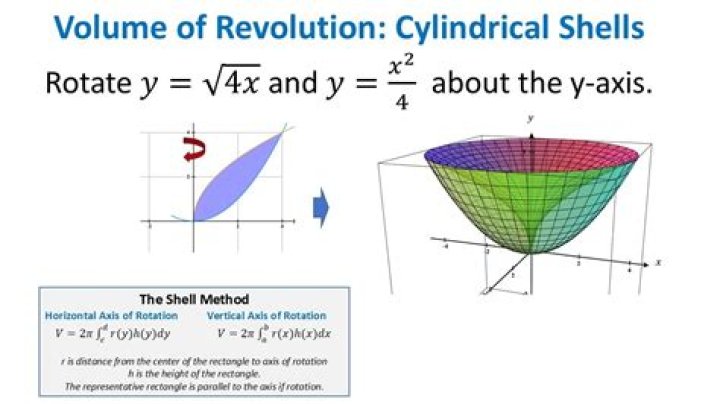
$\begingroup$For the "cylindrical shell" method, the "slices" are always parallel to the rotation axis. For any solid of revolution problem, the "radius" is always perpendicular to the rotation axis. Since the rotation axis is "vertical", the radius will be "horizontal"; the axis is just the $ \ y-$ axis, so we use $ \ r \ = \ x \ $ . Also, the "thickness" of each shell is $ \ dx \ , $ hence the integration will be in the $ \ x-$ direction. The shell "height" is the "vertical distance" between the two curves (just as in an "area between curves" problem).
For Question 1, the "upper curve" is the parabola, so the integral is
$$ V \ = \ 2 \pi \ \int_0^3 \ \ x \ \cdot [ \ (3 + 2x - x^2) \ - \ (3 - x) \ ] \ \ dx \ \ . $$
I agree with your volume for Question 2 by shell method.
The "disk/washer" method requires "slices" perpendicular to the rotation axis. The "thickness" of the slices will then be $ \ dy \ , $ requiring us to integrate in the $ \ y-$ direction.
Remember that the vertical bounding lines are $ \ x = 1 \ $ and $ \ x = 2 \ , $ so the hyperbola $ \ y = \frac{1}{x} \ $ intersects them at $ \ (1, 1 ) \ $ and $ \ (2, \frac{1}{2}) \ $ . We will need to integrate from $ \ y = 0 \ $ to $ \ y = 1 \ , $ except that there are two integrals to write. The first, over $ \ y = 0 \ $ to $ \ y = \frac{1}{2} \ $ has "washers" (annuli) with "outer radii" of 2 units and "inner radii" of 1 unit. The second, over $ \ y = \frac{1}{2} \ $ to $ \ y = 1 \ $ still uses "inner radii" of 1 unit, but the "outer radii" are $ \ x(y) = \frac{1}{y} \ . $ The total volume for the solid is then given by
$$ V \ = \ \pi \ \int_0^{1/2} \ 2^2 \ - \ 1^2 \ \ dy \ \ + \ \ \pi \ \int_{1/2}^1 \ \left( \frac{1}{y} \right)^2 \ - \ 1^2 \ \ dy \ . $$
We indeed obtain $ \ 2 \pi \ $ once again. (This is an example of a volume integration where inverting the curve function(s) and performing the integration is not difficult, but the geometry of the region makes the shell-method integration preferable.)
[It is generally a good idea to make some sort of sketch of the geometric situation in setting up any of the problems for area-between-curves, solid-of-revolution, surface-area-of-revolution, etc.]
$\endgroup$