Boundary of a 3-simplex.
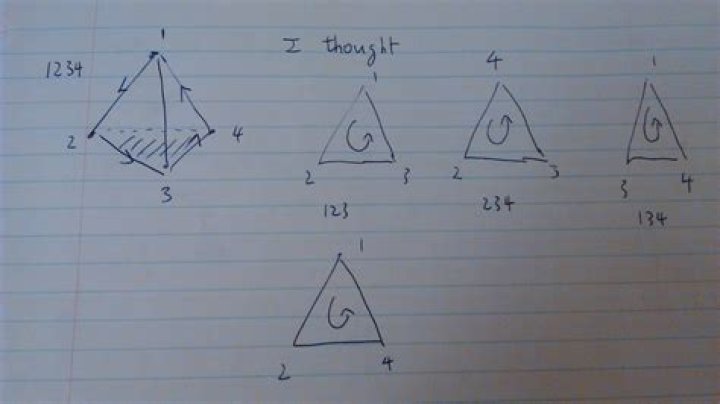
Label the vertices of the 3-simplex pyramid (1,2,3,4) by $1,2,3,4$. If one follows the brute force formula, we know the boundary equals $234-134+124-123$.
Traversing by the indices in the order $1,2,3,4$ (the default orientation), I am getting $123+234+134+124$. Rearranging gives me $234 + 134 + 124 + 123$.
I thought by default the simplex $1 \to 2 \to 3 \to 4$ goes in that order so why are $123$ and $134$ negative? Note that working backwards will get me the negative on $123$ because of how $341$ is defined.
1 Answer
$\begingroup$I'm not sure where you got the idea that you should get $123+234+134+124$. That's simply not the definition of the boundary. The definition of the boundary is the alternating sum $234-134+124-123$. When you write $123+234+134+124$, all you're doing is listing out all of the boundary faces and adding them up. That's a perfectly good operation to do if you want, but it's not the definition of the boundary.
I think you are perhaps confusing the natural induced ordering on the vertices of each boundary face with the natural orientation on each boundary face as part of the boundary. Each boundary face has a natural order on its vertices, given by just restricting the order on the vertices of the entire simplex. Each boundary face also has an orientation which makes it "face outwards" as part of the boundary of the simplex. However, these two notions are not the same: the order of the vertices in the boundary face need not be compatible with its orientation as a boundary face. Indeed, for (about) half of the faces this is not true, and those are exactly the faces which receive a minus sign in the boundary formula.
It may be helpful to consider the case of a $1$-simplex $12$. Here there is only one possible ordering for the boundary faces, since they have only one vertex. However, when you take the boundary, you still take the difference $2-1$, with a minus sign on the $1$.
$\endgroup$ 28