Boolean algebra - Maxterms
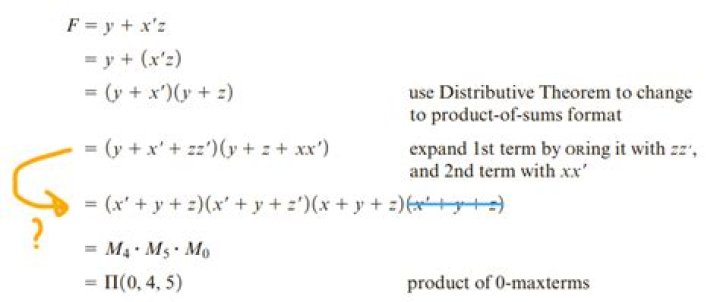
I have a boolean expression and I need to get to its canonical forms (sum of minterms and product of maxterms).
In order to get an expression for the first canonical form, I need to multiply every term by $(x + x')$, where $x$ is the missing variable of this term. Is there a similar algorithm to get to the second canonical form (product of maxterms)?
$\endgroup$1 Answer
$\begingroup$For small expressions, you can write down the truthtable. The maxterms correspond to the truthtable rows with output value 0. Invert all literals in these rows to get the maxterms.
Example:
F := a xor b xor c
Truthtable:
a b c F
0 0 0 0
0 0 1 1
0 1 0 1
0 1 1 0
1 0 0 1
1 0 1 0
1 1 0 0
1 1 1 1
Rows with 0 output:
a b c F
0 0 0 0
0 1 1 0
1 0 1 0
1 1 0 0
Maxterms:
a b c
1 1 1
1 0 0
0 1 0
0 0 1
Conjunctive Normal Form (CNF)
(a + b + c)(a + !b + !c)(!a + b + !c)(!a + !b + c)
Note that the CNF is not always unique. For many expressions, it is possible to derive different equivalent CNFs.
Prof. Jason Eisner's recipe to convert expressions to CNF:
CONVERT(φ): // returns a CNF formula equivalent to φ
// Any syntactically valid propositional formula φ must fall into
// exactly one of the following 7 cases (that is, it is an instanceof
// one of the 7 subclasses of Formula).
If φ is a variable, then: return φ. // this is a CNF formula consisting of 1 clause that contains 1 literal
If φ has the form P ^ Q, then: CONVERT(P) must have the form P1 ^ P2 ^ ... ^ Pm, and CONVERT(Q) must have the form Q1 ^ Q2 ^ ... ^ Qn, where all the Pi and Qi are disjunctions of literals. So return P1 ^ P2 ^ ... ^ Pm ^ Q1 ^ Q2 ^ ... ^ Qn.
If φ has the form P v Q, then: CONVERT(P) must have the form P1 ^ P2 ^ ... ^ Pm, and CONVERT(Q) must have the form Q1 ^ Q2 ^ ... ^ Qn, where all the Pi and Qi are dijunctions of literals. So we need a CNF formula equivalent to (P1 ^ P2 ^ ... ^ Pm) v (Q1 ^ Q2 ^ ... ^ Qn). So return (P1 v Q1) ^ (P1 v Q2) ^ ... ^ (P1 v Qn) ^ (P2 v Q1) ^ (P2 v Q2) ^ ... ^ (P2 v Qn) ... ^ (Pm v Q1) ^ (Pm v Q2) ^ ... ^ (Pm v Qn)
If φ has the form ~(...), then: If φ has the form ~A for some variable A, then return φ. If φ has the form ~(~P), then return CONVERT(P). // double negation If φ has the form ~(P ^ Q), then return CONVERT(~P v ~Q). // de Morgan's Law If φ has the form ~(P v Q), then return CONVERT(~P ^ ~Q). // de Morgan's Law
If φ has the form P -> Q, then: Return CONVERT(~P v Q). // equivalent
If φ has the form P <-> Q, then: Return CONVERT((P ^ Q) v (~P ^ ~Q)).
If φ has the form P xor Q, then: Return CONVERT((P ^ ~Q) v (~P ^ Q)).