Bayes' rule with 3 variables
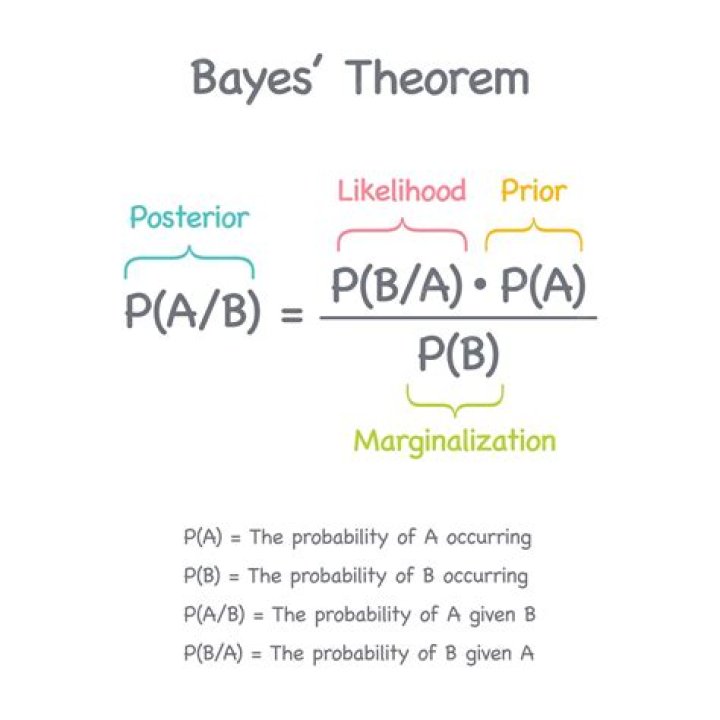
I have been using Sebastian Thrun's course on AI and I have encountered a slightly difficult problem with probability theory.
He poses the following statement:
$$ P(R \mid H,S) = \frac{P(H \mid R,S) \; P(R \mid S)}{P(H \mid S)} $$
I understand he used Bayes' Rule to get the RHS equation, but fail to see how he did this. If somebody could provide a breakdown of the application of the rule in this problem that would be great.
$\endgroup$2 Answers
$\begingroup$Taking it one step at a time: $$\begin{align} \mathsf P(R\mid H, S) & = \frac{\mathsf P(R,H,S)}{\mathsf P(H, S)} \\[1ex] & =\frac{\mathsf P(H\mid R,S)\,\mathsf P(R, S)}{\mathsf P(H, S)} \\[1ex] & =\frac{\mathsf P(H\mid R,S)\,\mathsf P(R\mid S)\,\mathsf P(S)}{\mathsf P(H, S)} \\[1ex] & =\frac{\mathsf P(H\mid R,S)\,\mathsf P(R\mid S)}{\mathsf P(H\mid S)}\frac{\mathsf P(S)}{\mathsf P(S)} \\[1ex] & =\frac{\mathsf P(H\mid R,S)\;\mathsf P(R\mid S)}{\mathsf P(H\mid S)} \end{align}$$
$\endgroup$ 6 $\begingroup$You don't really need Bayes' Theorem. Just apply the definition of conditional probability in two ways. Firstly,
\begin{eqnarray*} P(R\mid H,S) &=& \dfrac{P(R,H\mid S)}{P(H\mid S)} \\ && \\ \therefore\quad P(R,H\mid S) &=& P(R\mid H,S)P(H\mid S). \end{eqnarray*}
Secondly,
\begin{eqnarray*} P(H\mid R,S) &=& \dfrac{P(R,H\mid S)}{P(R\mid S)} \\ && \\ \therefore\quad P(R,H\mid S) &=& P(H\mid R,S)P(R\mid S). \end{eqnarray*}
Combine these two to get the result.
$\endgroup$ 5