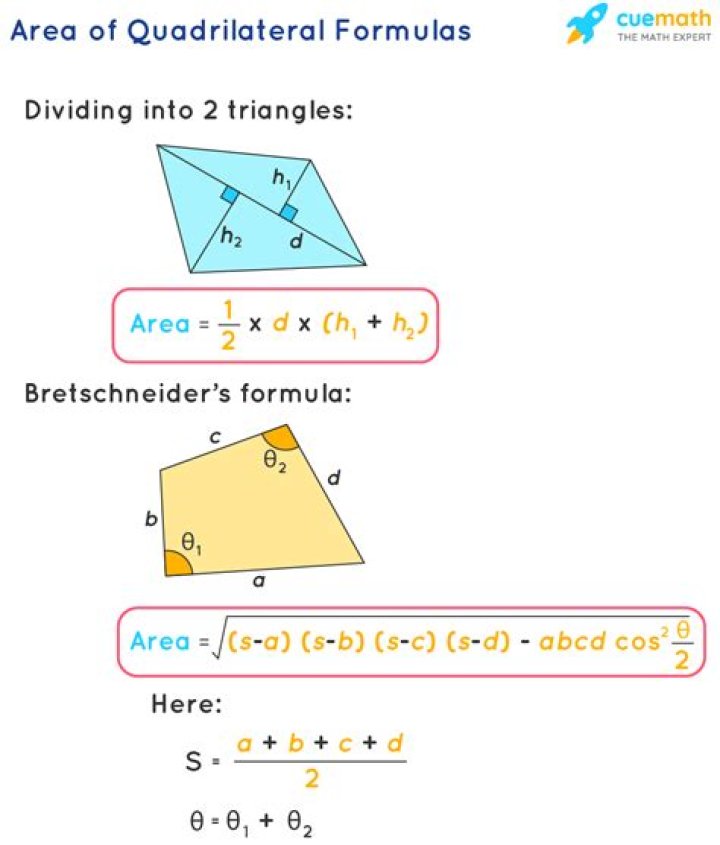
Area of an irregular quadrilateral.
An irregular quadrilateral has lengths $1, 4, 7$ and $8$ units. What is the maximum area of the quadrilateral possible?
To find the area of an irregular quadrilateral, five values are needed; four sides along with an angle or the size of at least one diagonal. However, I am not able to figure out how to get one angle or the size of one diagonal?
$\endgroup$ 12 Answers
$\begingroup$Given any quadrilateral $Q$ with side $a,b,c,d$. Let $s = \frac12(a+b+c+d)$ be the semi-perimeter and $2\theta$ be the sum of two opposite angles of $Q$. The area of $Q$ is given by theBretschneider's formula
$$\verb/Area/ = \sqrt{(s-a)(s-b)(s-b)(s-c) - abcd\cos^2\theta}$$
It is clear this area is maximized when $\cos\theta = 0$, i.e. when $Q$ is a cyclic quadrilateral. In that case, the formula reduce toBrahmagupta's formula:
$$\verb/Area/ = \sqrt{(s-a)(s-b)(s-b)(s-c)}$$
For the problem at hand, $(a,b,c,d) = (1,4,7,8) \implies s = 10$. The desired maximum area is $$\sqrt{(10-1)(10-4)(10-7)(10-8)} = 18$$
$\endgroup$ 3 $\begingroup$Let the diagonal be $d$. By Heron's formula
$$2A=\sqrt{(1+4+d)(1+4-d)(1-4+d)(-1+4+d)}+\sqrt{(7+8+d)(7+8-d)(7-8+d)(-7+8+d)}\\ =\sqrt{(5^2-d^2)(d^2-3^2)}+\sqrt{(15^2-d^2)(d^2-1^2)}.$$
You can optimize for $d^2$.
This leads to a polynomial equation as
$$\left(\sqrt{p(d_2)}+\sqrt{q(d_2)}\right)'=0$$ when
$$p'^2(d_2)\,q(d_2)=p(d_2)\,q'^2(d_2).$$
As the polynomials in the two members have the same leading coefficient, the equation is cubic in $d_2$.
$\endgroup$