Are upper triangular matrices with real entries associative?
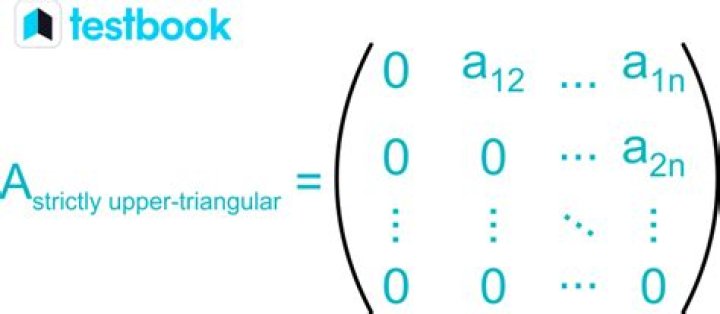
I'm trying to disprove that with a,b,c belonging to the real numbers, that the matrix \begin{bmatrix} a & b \\ 0& c\end{bmatrix}
is NOT a group under matrix multiplication. With the criteria for a group being closure, identity, associativity, and inverse; I think that it fails associativity. Can someone explain this? Thanks in advance
Also I tried formatting the matrix as a $2\times2$ but under the preview it shows [a b 0 c] - Sorry about that
$\endgroup$ 81 Answer
$\begingroup$A square matrix is invertible if and only if its determinant is not zero. Hence for your problem you have that matrices with either $a_{11}=0$ and/or $a_{22}=0$ are not invertible since $\text{det}(A)=a_{11}a_{22}-a_{21}a_{12}$. In fact those are the only non invertible matrices (since $a_{21}$ is always zero), since assuming $a_{11}\neq 0 \neq a_{22}$ you would obtain $\text{det}(A)\neq 0$ and thus $A$ would be invertible (in $\text{Mat}_{2 \times2}(k)$). However one needs to point out that your inverse would have be an upper triangular matrix as well in order for $G$ to be a group (pretending we don't know that its not), which implies that $\text{det}(A) \neq 0$ is not necessarily sufficient for $A$ to have an inverse in $G$ (since $\text{det}(A) \neq 0$ only ensures that it is invertible in $\text{Mat}_{2 \times2}(k)$).
$\endgroup$