Are there any functions that are (always) continuous yet not differentiable? Or vice-versa?
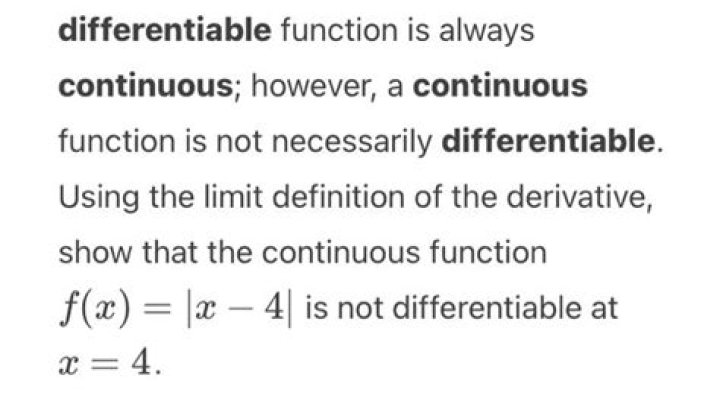
It seems like functions that are continuous always seem to be differentiable, to me. I can't imagine one that is not. Are there any examples of functions that are continuous, yet not differentiable?
The other way around seems a bit simpler -- a differentiable function is obviously always going to be continuous. But are there any that do not satisfy this?
$\endgroup$ 15 Answers
$\begingroup$It's easy to find a function which is continuous but not differentiable at a single point, e.g. $f(x) = |x|$ is continuous but not differentiable at $0$.
Moreover, there are functions which are continuous but nowhere differentiable, such as the Weierstrass function.
On the other hand, continuity follows from differentiability, so there are no differentiable functions which aren't also continuous. If a function is differentiable at $x$, then the limit $(f(x+h)-f(x))/h$ must exist (and be finite) as $h$ tends to 0, which means $f(x+h)$ must tend to $f(x)$ as $h$ tends to 0, which means $f$ is continuous at $x$.
$\endgroup$ 3 $\begingroup$Actually, in some sense, almost all of the continuous functions are nowhere differentiable:
$\endgroup$ $\begingroup$A natural class of examples would be paths of Brownian motion. These are continuous but non-differentiable everywhere.
You may also be interested in fractal curves such as the Takagi function, which is also continuous but nowhere differentiable. (I think Wikipedia calls it the "Blancmange curve".) I like this one better than the Weierstrass function, but this is personal preference.
$\endgroup$ $\begingroup$I really like this answer I went over in my lecture:
Try $f(x)=x^n$ ; $(0<n<1)$, it's continuous in R but not differentiable at $0$. Also, consider another function, $sin^{-1}(x)$, It is continuous at $1$, but not differentiable at $1$.
$\endgroup$ 1