$\arcsin x- \arccos x= \pi/6$, difficult conclusion
I do not understand a conclusion in the following equation. To understand my problem, please read through the example steps and my questions below.
Solve:
$\arcsin x - \arccos x = \frac{\pi}{6}$
$\arcsin x = \arccos x + \frac{\pi}{6}$
Substitute $u$ for $\arccos x$
$\arcsin x = u + \frac{\pi}{6}$
$\sin(u + \frac{\pi}{6})=x$
Use sum identity for $\sin (A + B)$
$\sin(u + \frac{\pi}{6}) = \sin u \cos\frac{\pi}{6}+\cos u\sin\frac{\pi}{6}$
$\sin u \cos \frac{\pi}{6} + \cos u\sin\frac{\pi}{6} =x$
I understand the problem up to this point. The following conclusion I do not understand:
$\sin u=\pm\sqrt{(1 - x^2)}$
How does this example come to this conclusion? What identities may have been used? I have pondered this equation for a while and I'm still flummoxed. All advice is greatly appreciated.
Note: This was a textbook example problem
$\endgroup$ 12 Answers
$\begingroup$The easy way to do this is to start with:
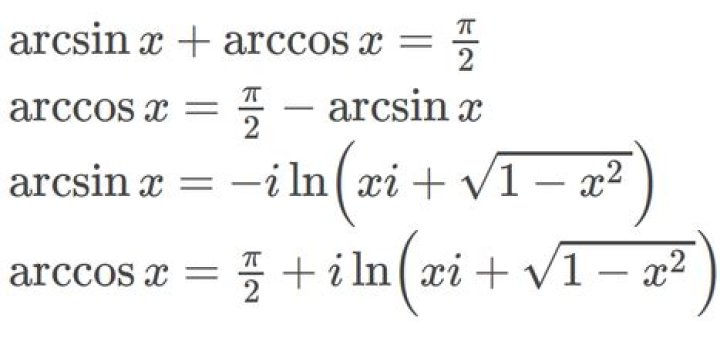
$\arccos x = \frac {\pi}{2} - \arcsin x$
Then your problem becomes
$2\arcsin x - \frac {\pi}{2} = \frac {\pi}{6}\\ x = \sin \frac {\pi}{3} = \frac {\sqrt3}2$
Now what have you done?
$\sin (u + \frac \pi6) = x\\ \frac 12 \cos u + \frac {\sqrt{3}}{2}\sin u = x\\ \frac 12 x + \frac {\sqrt{3}}{2}\sqrt{1-x^2} = x$
Why does $\sin (\arccos x) =\sqrt {1-x^2}?$
Draw a right triangle with base $= x$ and hypotenuse $= 1.$
For that angle $u, \cos u = x.$ What is the length of the opposite leg? $\sqrt {1-x^2}$
The range of $\arccos x$ is $[0, \pi]$ so $\sin (\arccos x) \ge 0$
$\sqrt{3}\sqrt{1-x^2} = x\\ \sqrt{3}(1-x^2) = x^2\\ 4x^2 = 3\\ x = \sqrt{\frac 34} $
We can reject the negative root as $x$ must be greater than $0$ as $\arcsin x - \arccos x < 0$ when $x<0$
$\endgroup$ 2 $\begingroup$Hint:
if $u=\arccos (x)$ than
$\cos u=x$
and
$\sin u=\pm\sqrt{1-\cos^2u}=\pm \sqrt{1-x^2}$
substitute and square your equation and you have
$ \frac{3}{4}(1-x^2)=\frac{1}{4}x^2 $
that can be solved, (with care to improper solutions).
$\endgroup$