Apollonius circle
I'm given two points, $A$ and $B$, and two lengths, $b$ and $c$. I need to find the locus of point $C$ such that $BC:AC=b:c$.
This link describes Apollonius circle of first type, but I can't seem to find anywhere how to construct the center of the Apollonius circle.
$\endgroup$ 04 Answers
$\begingroup$I didn't want any confusion, so I changed the symbols.
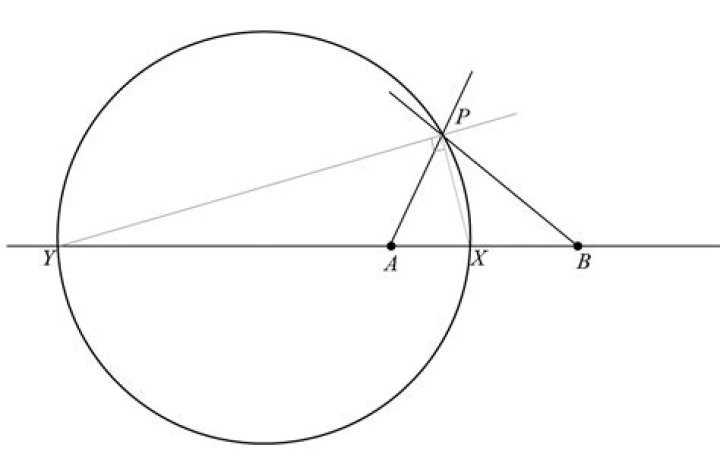
The set of all points $Z$ such that $$|PZ| : |QZ| = p : q$$ is called the Apollonius circle (please note that some other circles might also be called by this name).
The construction is rather simple:
- Build perpendicular segment $P'P'' \perp PQ$ such that $|PP'| = |PP''| = p$
- Build perpendicular segment $QQ' \perp PQ$ such that $|QQ'| = q$.
- Set $X$ to be the intersection of $P'Q'$ and $PQ$.
- Set $Y$ to be the intersection of $P''Q'$ and $PQ$.
- Both $X$ and $Y$ belong to the Apollonius circle, as the circle has to be symmetric with respect to the $PQ$ line, its center $M$ is the midpoint of $XY$.
A sketch of the construction is presented in the picture below. Also, observe that the $P'P''$ does not have to be perpendicular to $PQ$, the important property is $P'P'' \parallel QQ'$, however, in most cases, this is the simplest approach.
I hope it helps ;-)
$\endgroup$ 2 $\begingroup$If you are given the point $D$ that fulfils the ratio on the line between $A$ and $B$, you can find the locus of similar points (the Apollonius circle of first type) through the following construction:
Construct the circle $\color{#0B2}{\Gamma}$ centred on $D$ through the nearer of $A$ and $B$, which I will assume is point $B$. Also construct a line perpendicular to $AB$ at $B$. Then form the tangent to circle $\Gamma$ from $A$. This intersects the perpendicular at $E$ which is on the Apollonius circle. Since $AE$ is in fact tangent to this circle, you can construct the perpendicular at $E$ and the intersect with $AB$ will be the centre of the Apollonius circle $O$ (going though both $D$ and $E$).
Note that $E$ is on the Apollonius circle because $\triangle AEB$ is similar to the right triangle $\triangle ADT$ (with $T$ the tangent point of $A$ on $\Gamma$), so $|AE|:|EB| = |AD|:|DT| = |AD|:|BD|$ as required.
Since $|AE|:|EB| = |AD|:|BD|$, $ED$ bisects $\angle BEA$ giving $\angle BED = \angle DEA$. Also $\triangle DOE$ is isosceles so $\angle OED = \angle ODE$. Thus $\angle OEA = \angle OED + \angle DEA = \angle ODE + \angle BED = \color{red}{\perp}$ due to $\triangle BED$.
$\endgroup$ $\begingroup$Assuming that length $ AB< b+c$ draw arcs of lengths $(b,c)$ with centers at A,B to find point C. Let the internal /external angle green bisectors intersect line AB at P,Q.
The required locus is a circle on diameter PQ. Find center point of PQ and complete the Apollonian Circle... in the classical way.
If you can find three points that lie on the circle, or three lines that are tangent to it somewhere, then all you have to do is construct the circumcenter or incenter of the triangle formed by those points. I am not sure how to find those points or lines, however, but maybe you already found that?
$\endgroup$