Adjacent edges in graph theory
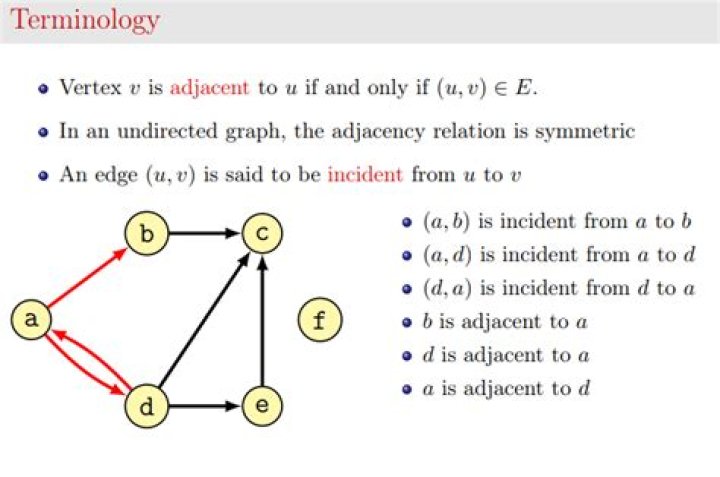
May be a foolish question, but why is it always being said that "Two non-parallel edges are said to be adjacent if they are incident on a common vertex."
What about a situation where there exist more than two non-parallel edges having a common vertex?
I'm an extreme newbie to mathematics so if this is a foolish question kindly forgive me please..
$\endgroup$ 23 Answers
$\begingroup$We would not say the set of edges are adjacent, but that each of the pairs of edges are adjacent (or the set of edges are pairwise adjacent). This holds more generally than what you are saying, it implies that any two edges in the set share a common vertex (and does require that all the edges share the same common vertex).
The term "adjacency" mostly is used to refer to vertices, and is applied to edges through the idea of looking at the line graph, and whether two edges in the original graph correspond to adjacent vertices in the edge graph.
$\endgroup$ $\begingroup$It's just a choice of definition really. Being adjacent is something that two edges can be, because that is how we define it.
You are correct that if three non-parallel edges happen to have a common vertex, then it would make sense from an intuitive stand-point to speak of all three edges as adjacent. One could have defined it that way, but one hasn't.
Luckily, if $e$, $f$, and $g$ are three non-parallel edges that all have the vertex $v$ in common, then $e$ and $f$ are adjacent, $e$ and $g$ are adjacent, and $f$ and $g$ are adjacent, so not much is lost in not being able to talk about "the adjacency of three edges".
$\endgroup$ 7 $\begingroup$All is incident at that vertex as apply definition for any two edges.
All vertices are adjacent, and all edges are incident.
Read for more Graph theory: adjacency vs incident
$\endgroup$