Absolute continuity of the Lebesgue integral
This is an exercise that I am having trouble with. Not for a grade just for practice. Its an obvious result intuitively but I am having trouble making a rigorous argument.
Assume $f$ is Lebesgue integrable on $E$. Prove that for all $\varepsilon>0$ there exists a $\delta>0$ such that if the Lebesgue measure of $A$ is less than $\delta$, the integral of $|f|$ over $A$ is less than $\varepsilon$. Here $A$ is a subset of $E$.
Anyone have any ideas?
$\endgroup$ 14 Answers
$\begingroup$Note that, by the Lebesgue dominated convergence theorem, we have that $$\lim_{\lambda \to\infty}\int_{\{|f| > \lambda\}}|f|\ d\mu = 0.$$ This follows easily since $\chi_{\{|f| > \lambda\}}|f| \le |f| \in L^1$ and $\chi_{\{|f| > \lambda\}}|f| \to 0$ since $f$, being integrable, is finte almost everywhere.
Let $\epsilon > 0$, then there exists $\lambda > 0$ such that $$\int_{\{|f| > \lambda\}}|f|\ d\mu < \frac{\epsilon}{2}.$$
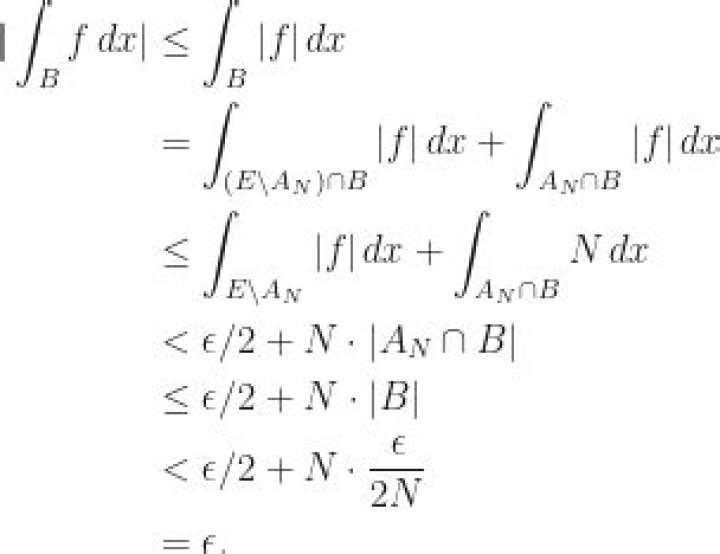
Choose $\delta \le \frac{\epsilon}{2\lambda}$ and take any measurable set $A$ such that $\mu(A) < \delta$. Then we have $$\int_A|f|\ d\mu = \int_{A \cap \{|f| > \lambda\}}|f|\ d\mu + \int_{A \cap \{|f| \le \lambda\}}|f|\ d\mu \le$$ $$\le \int_{\{|f| > \lambda\}}|f|\ d\mu + \int_{A \cap \{|f| \le \lambda\}}\lambda\ d\mu$$
note that this last inequality follows from the fact that $A \cap \{|f| > \lambda\} \subset \{|f| > \lambda\}$ and the fact that $|f| \le \lambda$ on $A \cap \{|f| \le \lambda\}$. Then we are done since $$\int_{\{|f| > \lambda\}}|f|\ d\mu + \int_{A \cap \{|f| \le \lambda\}}\lambda\ d\mu \le \frac{\epsilon}{2} + \delta \lambda \le \epsilon.$$ This concludes the proof! :D
$\endgroup$ 13 $\begingroup$It is given that $f$ is integrable, so $$\int_E|f|d\mu=L<\infty.$$ Choose a simple function $0\leq g\leq|f|$ with $$g=\sum_{i=1}^Ng_i\mathbf{1}_{A_i}$$ such that $$\int_E(|f|-g)d\mu<\frac{\epsilon}{2}.$$
Let $G=\max (g_i)$ and choose $\delta<\frac{\epsilon}{2GN}$.
For any $A$ with $\mu(A)<\delta$ we have $$ \begin{aligned} \int_A|f|d\mu&=\int_A(|f|-g)d\mu+\int_Agd\mu\\ &\leq\int_E(|f|-g)d\mu+\int_Agd\mu\\ &<\frac{\epsilon}{2}+\sum_{i=1}^Ng_i\mu(A_i\cap A)\\ &\leq\frac{\epsilon}{2}+GN\mu(A)\\ &<\frac{\epsilon}{2}+GN\delta\\ &<\frac{\epsilon}{2}+GN\frac{\epsilon}{2GN}=\epsilon. \end{aligned} $$
$\endgroup$ 4 $\begingroup$Since $f$ is Lebesgue integrable, without loss of generality, we assume $f\ge 0$. Assume the contrary, $\big(\exists \epsilon_0>0$ and a sequence of measurable subsets $(A_n)_{n=1}^\infty\big) \ni \big(\mu(A_n)\le\frac1{2^n}\ {\large\land}\ \int_{A_n}f>\epsilon_0,\forall n\in\mathbf N\big)$. $\Big(\int_{\cup_{n=m}^\infty A_n}f\ge\int_{A_k}f>\epsilon_0, \forall \big(k\ge m \land (k,m\in\mathbf N)\big)\Big){\large\land}\big(\int_{\cup_{n=m}^\infty A_n}f \text{ decreases with }m\big)\implies \int_{\cap_{m=1}^\infty\cup_{n=m}^\infty A_n}f=\lim\limits_{m\to\infty}\int_{\cup_{n=m}^\infty A_n}f\ge\epsilon_0.$ However, by Borel Cantelli lemma $\sum_{n=1}^\infty \mu(A_n)\le1<\infty \implies\mu(\cap_{m=1}^\infty\cup_{n=m}^\infty A_n)=0\implies \int_{\cap_{m=1}^\infty\cup_{n=m}^\infty A_n}f=0<\epsilon_0.$ A contradiction.
$\endgroup$ 14 $\begingroup$We can safely assume that $f \geq 0$. Then define
$$f_N(x):=f(x) \cdot \chi_{E_N}$$
where
$$E_N:=\{x: f(x) \leq N\}$$
Then the $f_N$ are measurable and furthermore one has for every $N \in \mathbb{N}$ that
$$f_N \leq f_{N+1}$$
Then by the Monotone Convergence Theorem one has for any given $\epsilon >0$ that there exists an $N \in \mathbb{N}$ such that
$$\int_{\mathbb{R}^d} f - f_N < \frac{\epsilon}{2} \space \space \space \space (*)$$
Then choose your $\delta>0$ such that $\delta>\frac{\epsilon}{2N}$. Then if $m(E)< \delta$ one can compute
\begin{equation} \begin{split} \int_E f &= \int_E f- f_N + \int_E f_N && \text{adding 1 trick}\\ &\leq \int_{\mathbb{R}^d} f - f_N + \int_E f_N && \text{monotonicity of Leb integral}\\ &\leq \int_{\mathbb{R}^d}f-f_N+Nm(E) && \text{by definition}\\ &\leq \frac{\epsilon}{2} + N\frac{\epsilon}{2N} && \text{since $m(E) < \delta$}\\ &= \epsilon. \end{split} \end{equation}And since $\epsilon$ was arbitrary, the proof is complete.
$\endgroup$