A question about discriminant
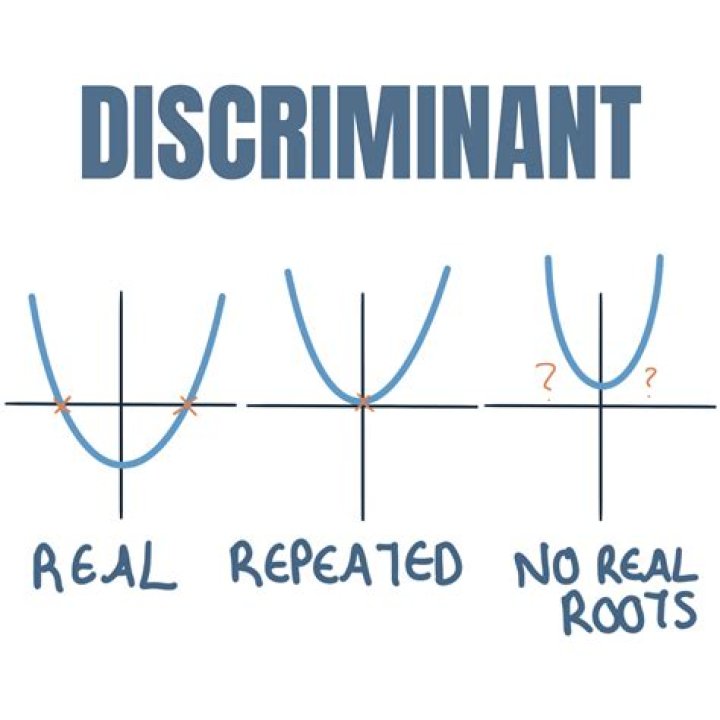
Lately I have been trying to think about equations in terms of graphs a lot and I stumbled on equation for solutions of quadratic equation, and I could not understand everything about it.
I can understand that $ \frac{-b}{2a}$ is supposed to result in the lowest point of the graph, but I can't quite wrap the head around how $ \sqrt{({\frac{b}{2a}})^2 - \frac{c}{a}} $ results in the distances of the zeroes from that lowest point. I had like some intuition behind what goes in there. Thanks!
$\endgroup$ 03 Answers
$\begingroup$Look at the following visual:
Let, $OA=\alpha$ and $OB=\beta$
By power of point for a circle, the length of the red line $=\sqrt{OA\cdot OB}=\sqrt{\alpha\cdot \beta}=\sqrt\frac ca$
Also, by Pythagoras Theorem, the length of the red line is $\sqrt{OC^2-AC^2}=\sqrt{(\frac{\alpha +\beta}{2})^2-AC^2}=\sqrt{(\frac{-b}{2a})^2-AC^2}$
Equate both the expressions to get your desired result.
$\endgroup$ 3 $\begingroup$Let $ax^2+bc+c$ be a quadratic polynomial and $\Delta=b^2-4ac.$
Thus, $a\neq0$ and $$ax^2+bx=c=a\left(x^2+\frac{b}{a}x+\frac{c}{a}\right)=$$$$=a\left(\left(x+\frac{b}{2a}\right)^2-\left(\frac{b^2}{4a^2}-\frac{c}{a}\right)\right)=a\left(\left(x+\frac{b}{2a}\right)^2-\frac{\Delta}{4a^2}\right).$$Now, we got a vertex of the parabola $y=ax^2+bx+c$: $$\left(-\frac{b}{2a},-\frac{\Delta}{4a}\right)$$ and we can answer now on some another questions.
For example, if $\Delta>0$ for difference between the polynomial roots we obtain: $\frac{\Delta}{|a|}.$
$\endgroup$ $\begingroup$Related to the discriminant it is half difference of the roots of the quadratic equation $ ax^2+bx+c=0$.
If it vanishes, the roots are equal and the LHS becomes a perfect square.
You are asking about geometric intuition of quantities related to $(a,b,c)$ coefficients of the quadratic.
The following sketch (parabola shown only between root locations for clarity) is relevant to your question through three recognizable and relatable lengths:
$$ OD^2=OS^2-DS^2$$
$OD$ is half-difference, $OS$ half-sum and $SD$ the product of its roots, so that the
Radius $OD= \sqrt {OS^2-DS^2} = \sqrt{\big(\dfrac{-b}{2a}\big)^2-\dfrac{c}{a}} $
The diagram is reminiscent of the pure Mohr's circle that represents important stress, strain, moment of inertia applications which are double subscripted tensors. They represent mean stress, $OD=$ shear stress causing failure causing shear stress.
A few years back in fact I raised this your very your question: Why the (half) difference of the roots of a quadratic equation is not placed on par with the (half) sum and root. I have to search for exact title. I am sure it arises in the minds of many pre-calculus students.