A new(?) proof of the Law of Cosines using segments determined by the points of contact with a triangle's incircle
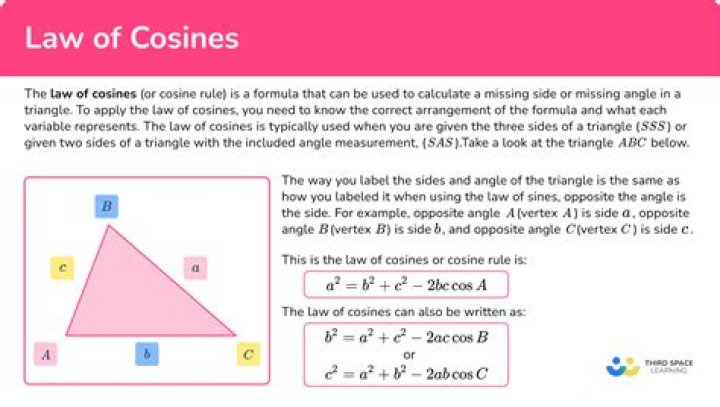
In trigonometry, the law of cosines (also known as the cosine formula, cosine rule, or al-Kashi's theorem) relates the lengths of the sides of a triangle to the cosine of one of its angles. Using standard notation, the law of cosines states
$$c^2=a^2+b^2-2ab\cos{\gamma}$$
where $\gamma$ denotes the angle contained between sides of lengths $a$ and $b$ and opposite the side of length $c$. The other two relations are analogous:
$$a^2=b^2+c^2-2ac\cos{\alpha}$$$$b^2=a^2+c^2-2ac\cos{\beta}$$
Proof. Let $D$, $E$ and $F$ be the contact points of the incircle with $AC$, $AB$ and $BC$, respectively. Also, let $AE=AD=x$; $BE=BF=y$; $CD=CF=z$. We start from two well-known relationships of a triangle: $$\sin^2{\frac{\gamma}{2}}=\frac{(s-a)(s-b)}{ab} \qquad\text{and}\qquad \cos^2{\frac{\gamma}{2}}=\frac{s(s-c)}{ab} \tag{1}$$ (See Cut-the-Knot's "Relations between various elements of a triangle" page for proofs.) Here, $s$ denotes the semiperimeter of $\triangle{ABC}$. Since $(s-a)=x$, $(s-b)=y$ and $(s-c)=z$, then the following identity holds:
$$xy\left[\frac{s(s-c)}{ab}\right]=sz\left[\frac{(s-a)(s-b)}{ab}\right]\tag{2}$$
Now, rewriting, $$\begin{align} xy\cos^2{\frac{\gamma}{2}}&=sz\sin^2{\frac{\gamma}{2}} \tag{3} \\[4pt] xy(1+\cos{\gamma}) &=sz(1-\cos{\gamma}) \tag{4} \\[4pt] xy(1+\cos{\gamma}) &=(xz+yz+z^2)(1-\cos{\gamma}) \tag{5} \end{align}$$Expanding, multiplying by 2, rearrenging and factoring, $$2xy=2yz+2xz+2z^2-2(y+z)(x+z)\cos{\gamma} \tag{6}$$Adding $x^2+y^2$ to both sides, $$\begin{align} x^2+2xy+y^2 &=(y^2+2yz+z^2)+(x^2+2xz+z^2)-2(y+z)(x+z)\cos{\gamma} \tag{7} \\[4pt] (x+y)^2 &=(y+z)^2+(x+z)^2-2(y+z)(x+z)\cos{\gamma} \tag{8} \\[4pt] c^2 &=a^2+b^2-2ab\cos{\gamma} \tag{9} \end{align}$$As desired. $\square$
A similar reasoning must show that $a^2=b^2+c^2-2bc\cos{\alpha}$ and $b^2=a^2+c^2-2ac\cos{\beta}$.
Is this new?
$\endgroup$ 2 Reset to default