A coin is flipped 4 times. Assume that all outcomes are equally likely. Let 𝐴 be the event that the first flip lands on heads.
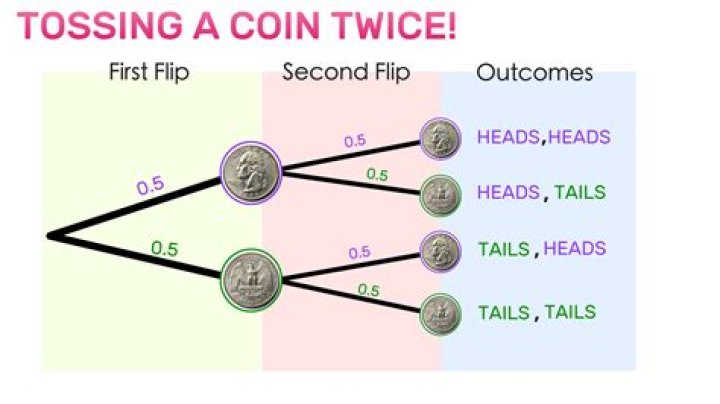
A coin is flipped 4 times. Assume that all outcomes are equally likely. Let 𝐴 be the event that the first flip lands on heads. Let 𝐵 be the event that there is an even number of tails. What is the probability of 𝑨? What is the probability of 𝑩? What is the probability of 𝑩 given 𝑨? Are 𝑨 and 𝑩 independent?
My work
$$P(A)=\frac 12$$ $$P(B)=\frac12$$ $$P(A\cap B )=\frac{3}{16}$$
$$P(B|A)=\frac{P(A\cap B )}{P(A)} = \frac{\frac{3}{16}}{\frac{1}{2}}=\frac 38$$
and $A$ and $B$ are not independent because $P(A).P(B)\neq P(A\cap B)$
$\endgroup$ 22 Answers
$\begingroup$Nope. $P(A \cap B) = \frac{1}{4}$. Could be HHHH, HTTH, HTHT, or HHTT. Your process is correct though.
As a sanity check: If you flip $n$ coins, the probability that an even number come up tails is always $\frac{1}{2}$, independent of $n$. This is because the last flip always has one outcome which will make the total even and one which will make it odd. Thus the outcome of the first flip (for $n > 1$) has no effect on the probability that the total number of tails is even, i.e. these are independent events.
$\endgroup$ 1 $\begingroup$I believe you've made an error asnwering the third question. If we assume A has occurred, that is the first coin landed on heads, then three coins remain to be flipped, giving us 8 possibilities. Of the 8, 4 contain even amounts of tails, specifically $HHH, HTT, THT, TTH$. Therefore assuming A, there is a $\left(\frac{4}{8}\right)$ or 50% chance that B occurs. Since the chance of A is 50% and the chance of B is 50%, then the chance that both A and B occur is 25%
$\endgroup$